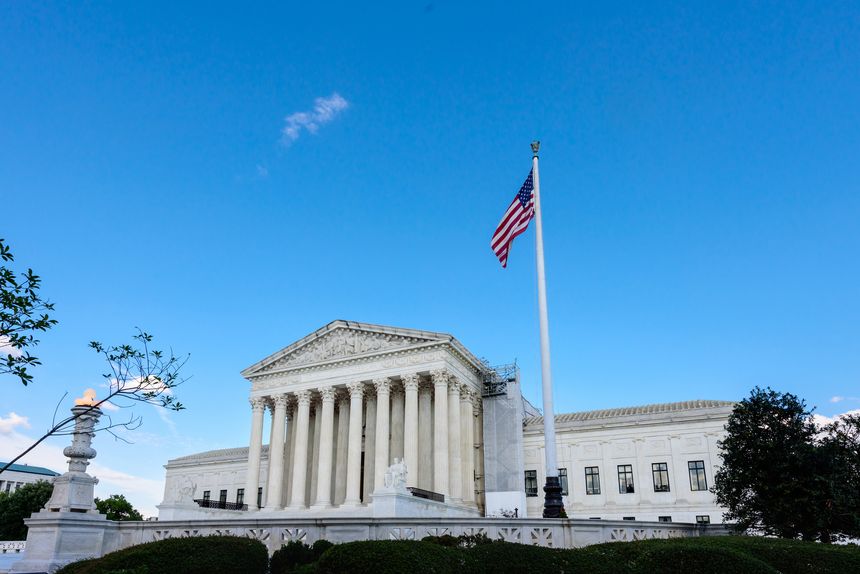


On June 15, 2026, the Supreme Court denied certiorari in National Shooting Sports Foundation, Inc. v. Letitia James, leaving in place the U.S. Court of Appeals for the Second Circuit’s decision upholding New York’s gun-industry public nuisance law against a facial pre-enforcement challenge. The denial of cert. suggests that states still have room to legislate against dangerous and unlawful gun-market practices, even in the shadow of the Protection of Lawful Commerce in Arms Act (PLCAA).
The New York law at issue, N.Y. General Business Law § 898-a–e, was enacted in 2021 in response to gun violence in the state. As described in the briefs, it prohibits gun-industry members from knowingly or recklessly creating, maintaining, or contributing to dangerous conditions in New York through unlawful or unreasonable conduct in the sale or marketing of firearms. It also requires industry participants selling in New York to establish and use “reasonable controls and procedures” to prevent unlawful possession, sale, and misuse of their products. The law can be enforced by the New York Attorney General, local government lawyers, and certain private plaintiffs who have been harmed.
The National Shooting Sports Foundation and other gun-industry challengers argued that the statute is preempted by the PLCAA, the 2005 federal law that generally bars civil actions seeking to hold firearms manufacturers and sellers liable for harms resulting from the criminal misuse of their products by third parties. But the PLCAA also contains exceptions—including the so-called “predicate exception,” which preserves suits based on knowing violations of state or federal statutes applicable to the sale or marketing of firearms. The Second Circuit held that, at least on its face, New York’s statute fits within that framework and can be applied consistently with the PLCAA. Because the plaintiffs brought a facial pre-enforcement challenge, they had to show there was no valid application of the law—a demanding burden they failed to meet.
Importantly, NSSF v. James was not itself an enforcement action about a particular ghost-gun sale; it was a facial pre-enforcement challenge brought by gun-industry plaintiffs to New York’s gun-industry public nuisance statute.
But the New York statute the Second Circuit upheld has already been invoked in separate enforcement litigation targeting alleged unlawful gun-market conduct. In The People of the State of New York v. Arm or Ally, LLC, 24-773, Attorney General Letitia James alleged that certain distributors sold and shipped unfinished frames, receivers, and build kits into New York—components that could be assembled into unserialized and untraceable firearms, often outside ordinary background-check, recordkeeping, and serialization requirements. The Attorney General alleged that distributors sold “tens of thousands” of illegal, unfinished frames and receivers to New Yorkers, which were then converted into ghost guns, and that those sales allegedly violated local, state, and federal laws, including by allowing weapons to be sold without background checks and to people such as felons or others who could not lawfully possess firearms.
These gun-industry actors were allegedly creating or feeding unlawful channels of access to weapons. The allegations against one distributor, Indie Guns, for example, illustrate the concern: the Attorney General asserted that the company sold parts used to make ghost guns, marketed itself as helping customers evade federal and state gun laws, and promoted ghost-gun products as “UNSERIALIZED UNREGISTERED UNTRACEABLE.” Those allegations fit within the broader risks New York’s statute seeks to address. Section 898 requires gun-industry members selling into New York to adopt “reasonable controls and procedures” to prevent their products from being possessed, used, marketed, or sold unlawfully in the state; the Second Circuit noted examples such as screening, security, inventory practices to prevent thefts, safeguards against sales to straw purchasers, traffickers, prohibited persons, or people at risk of injuring themselves or others, and measures to prevent deceptive practices and false advertising.
In that sense, while NSSF v. James tested the validity of the statute in the abstract, the ghost-gun cases show how the statute can be used in practice: to target alleged failures by industry actors to take basic measures against illegal distribution, trafficking, straw purchasing, deceptive marketing, and the flow of unserialized weapons into New York.
The holding in NSSF v. James also has broader implications beyond New York. Unlawful gun trafficking, straw purchasing, ghost-gun distribution, and other channels of illegal access do not stop at state borders. And New York’s opposition brief noted that petitioners themselves acknowledged that several other states have enacted analogous statutes designed to operate within PLCAA’s predicate exception. States should take note. They do not need to accept the false choice between doing nothing and running headlong into federal preemption. Thoughtfully drafted public nuisance and market-regulation statutes can target unlawful firearm practices while staying within the boundaries Congress drew.
The Supreme Court’s denial of cert. should therefore be read as a practical signal, even if not a precedential endorsement: carefully drafted state legislation in this area is not dead on arrival. Legislatures confronting unlawful gun markets should continue to create and refine public nuisance laws that require reasonable controls, deter unlawful distribution practices, and open a path to civil accountability where industry actors knowingly contribute to public harm.
/Passle/67ead603e72212c76f32080c/SearchServiceImages/2026-07-17-21-38-48-742-6a5aa0e8015b657b93670ee7.jpg)
/Passle/67ead603e72212c76f32080c/SearchServiceImages/2026-07-15-17-48-48-213-6a57c800f03bcb784b10f8ce.jpg)
/Passle/67ead603e72212c76f32080c/SearchServiceImages/2026-07-07-14-19-34-935-6a4d0af62c6b2a017681fa65.jpg)
/Passle/67ead603e72212c76f32080c/SearchServiceImages/2026-06-26-19-12-00-538-6a3ecf0002124ba92c8486ed.jpg)